
I had decided a few years ago that I wanted to consolidate all of my home's servers into a central place. I've had PCs, laptops, a fair number of Pis (raspberry and otherwise), scattered about the place doing odd jobs forever. I never thought much about it - there would be a problem I needed to solve (example: I wanted a time lapse of my backyard over the course of a year) and a computer would be the right tool to solve it (in this case, a Raspberry Pi 3b with a stationary camera in a 3d printed case). They would generally stick around as long as the problem needed solving (PorchPi was retired a few years ago, replaced by an ESP8266) and then be recycled into something more interesting at the time. Over the last decade or so, I've slowly been replacing most of the PCs with micro-controllers. This wasn't an intentional move, it just turned out that the ESP8266 (and later , ESP32) were more or less sufficient to accomplish most of what I had Pis, laptops, and old PCs deployed around the house for. This helped reduce power consumption and clutter, which were great, but the main advantage to me was the reduction in maintenance. The Pi3 was a great swiss army knife of basic computing, but it was slow as hell to troubleshoot on, even in just a shell. Anyways, this led to a desire to consolidate even more. At the same time I was wanting to build a dedicated AI Server to move the Meg and Bob workloads off of Jim....and I sort of got carried away and decided to rebuild the entire network in my house over the course of 6 months or so.
You know how it goes.
Switch
So I suppose it started when I found a good deal on a used datacenter layer 3 network switch last year. This had 48 PoE outputs, a good number of SFP+ ports for future expansion, and a fan loud enough drown out a punk band. I didn't end up keeping it (was way too loud), but I got an even better deal on a quieter sibling a few months later. I was getting tired of buying PoE switches and transformers for each room, and wanted to "solve that problem for good". I had a closet fairly centrally located in my house, and I convinced myself I needed to run all of the network cable in my house to it. This was, as it turned out, a much bigger task than I had asumed, but more on that later.
Getting back to Switch, (proper noun, this time - it found its name) it wouldn't be put into service for a good number of months, first some problems needed to be solved. The replacement was much quieter than the original, but it was still far too rowdy to sleep in the house. There was only one solution. Surgery. The switch has two noise levels, which I will call "Lawnmower Down the Street" and "Jet Engine in your Pants".


I gave Bob both sound levels as prompts. Which one do you want installed in your closet?
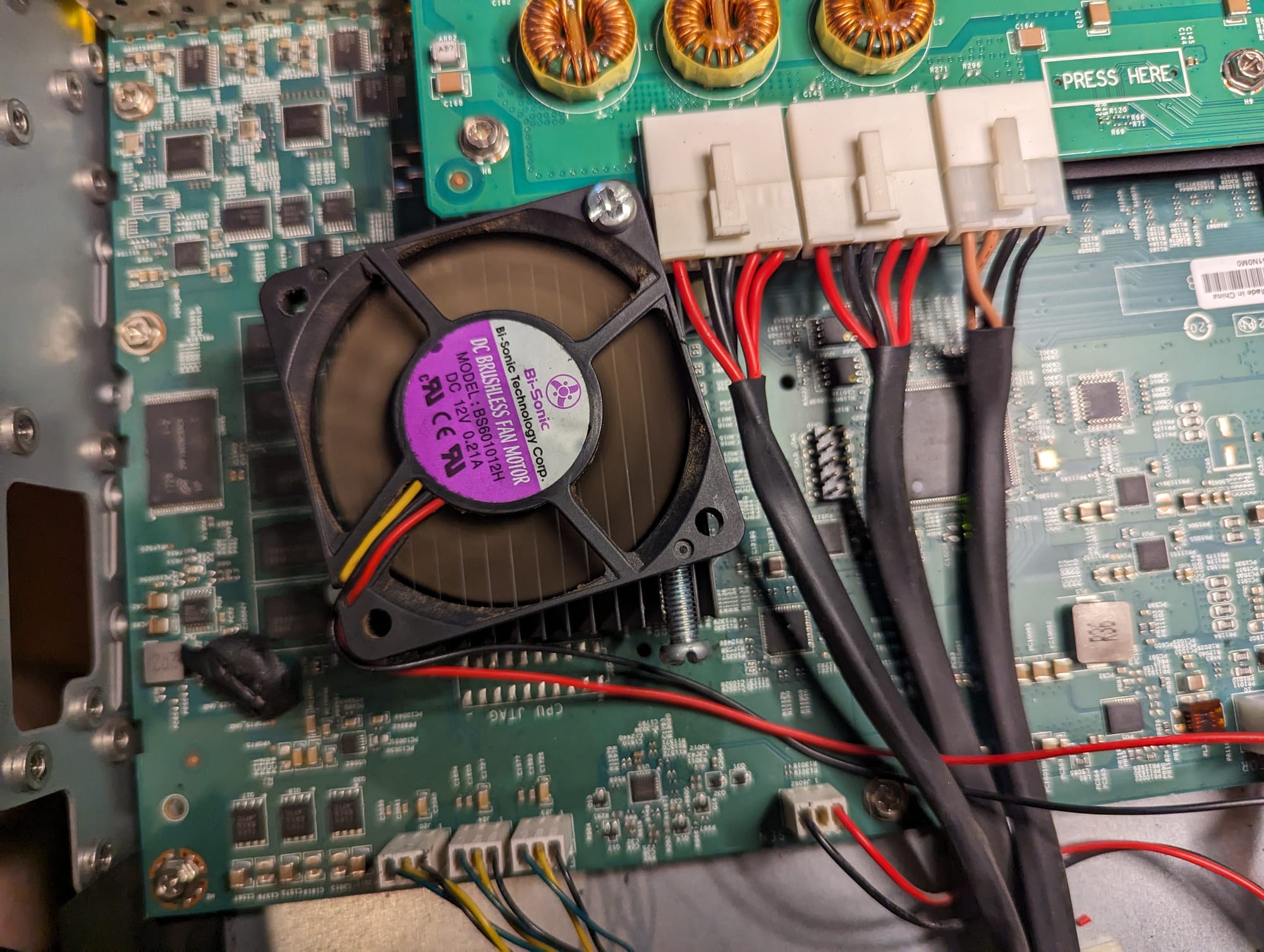
It kicks into jet engine mode if a thermal sensor on the board senses it getting over a (configurable) threshold. I replaced the fans with quieter models, but still wanted to prevent the jet engine from showing up. I ordered a 20mm fan from ebay hoping to use it to keep the inside of the switch cooler. The one I ordered ended up being junk, so I had to scavenge from my basement. I found a CPU fan from a Pentium era motherboard that was about the right size. It wasn't silent, but after some cleaning it spun fine. I stuck it on the hottest chip on the board, according to my IR thermometer. My theory was it would help keep us in lawnmower territory. Thankfully, this turned out to be correct.
All the Wires
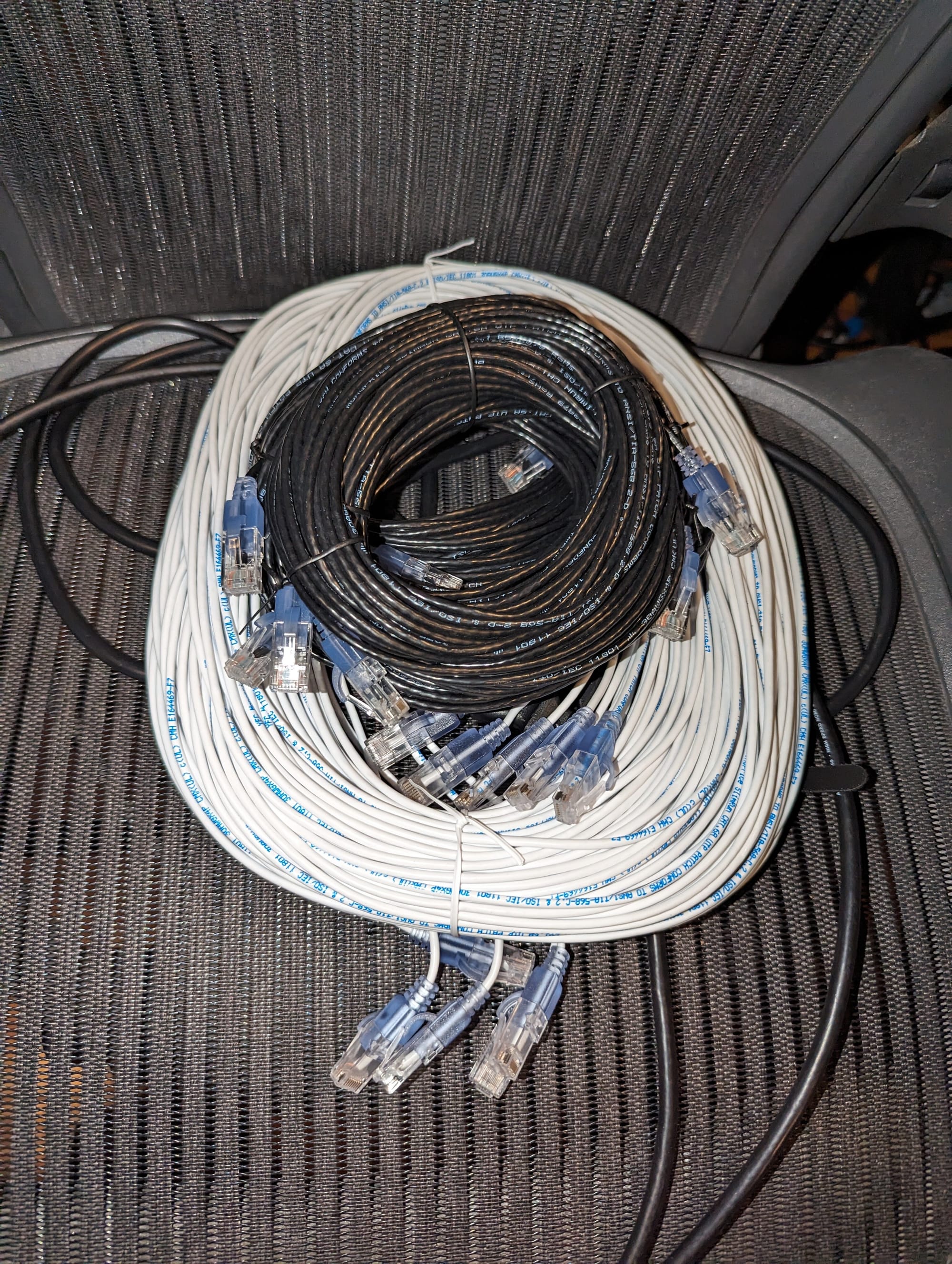
The jet engine tamed, I set to work assembling parts for a build that would take the next several months. I pulled new cat6a to each room and device. This involved a lot of crawling around in my attic and attacking my crawl space. My attic is one of those "hook a foam shredder to a giant blower on a 4' diameter hose" sorts of deals. There is a good 6-8" of insulation before you can even feel the top of the joists. Every time you open the door to get up there, it is like living next to a fiberglass confetti factory on a windy day.
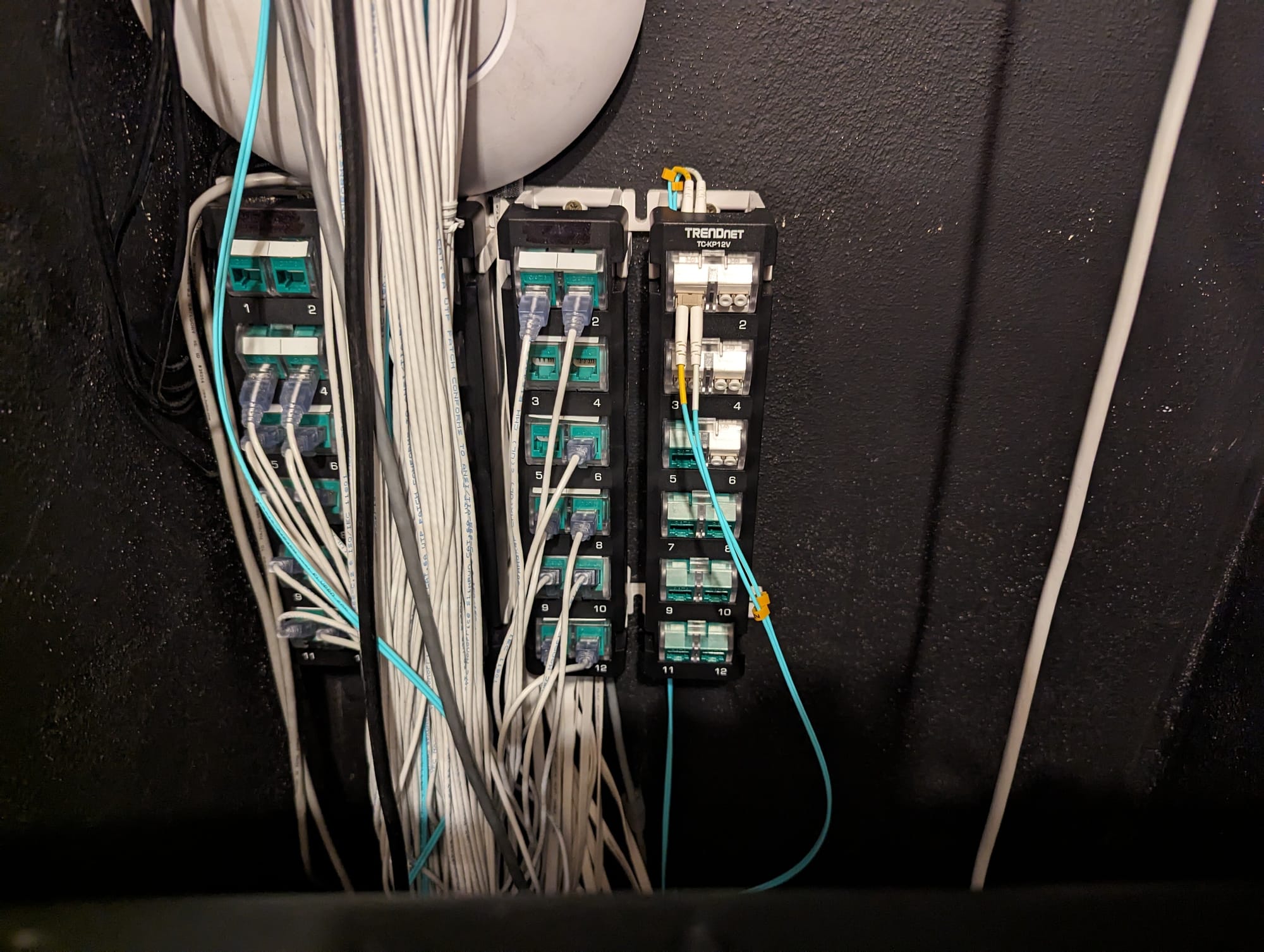
The crawlspace has air in it that hasn't circulated since the last three-term president. I try to stay out of both, so this took a lot of goading to get motivated on. I installed patch panels in the closet and ran all of the cable to it.
Then I went an extra step and built in 20' of slack cabling between the patch bays and my network rack. The rack is on casters, and this allows me to pull it out of the closet, and into one of several rooms to do maintenance, upgrades, or re-configurations, all without turning anything off or disconnecting any cables. Is this severe overkill? You're damn fucking right it is. I have hung off of my last rafter with a wire stripper and soldering iron in my hands and a roll of black tape in my teeth. If I'm going to "do it the right way" for a change, I might as well turn it up to 11.
With the new switch installed, I began the slow process of migrating all of my wired network to it. I have a fair number of cameras, a zigbee radio, and an assortment of PCs, media boxes, etc around the place, so it didn't take long to fill most of it. Once I got everything moved over, I was able to free up some ports by moving my main server, nas, and workstation to 10g/sec fiber. That opened 4 ports from Tubs, 2 from the new server, and 2 from Jim. Good enough for now.
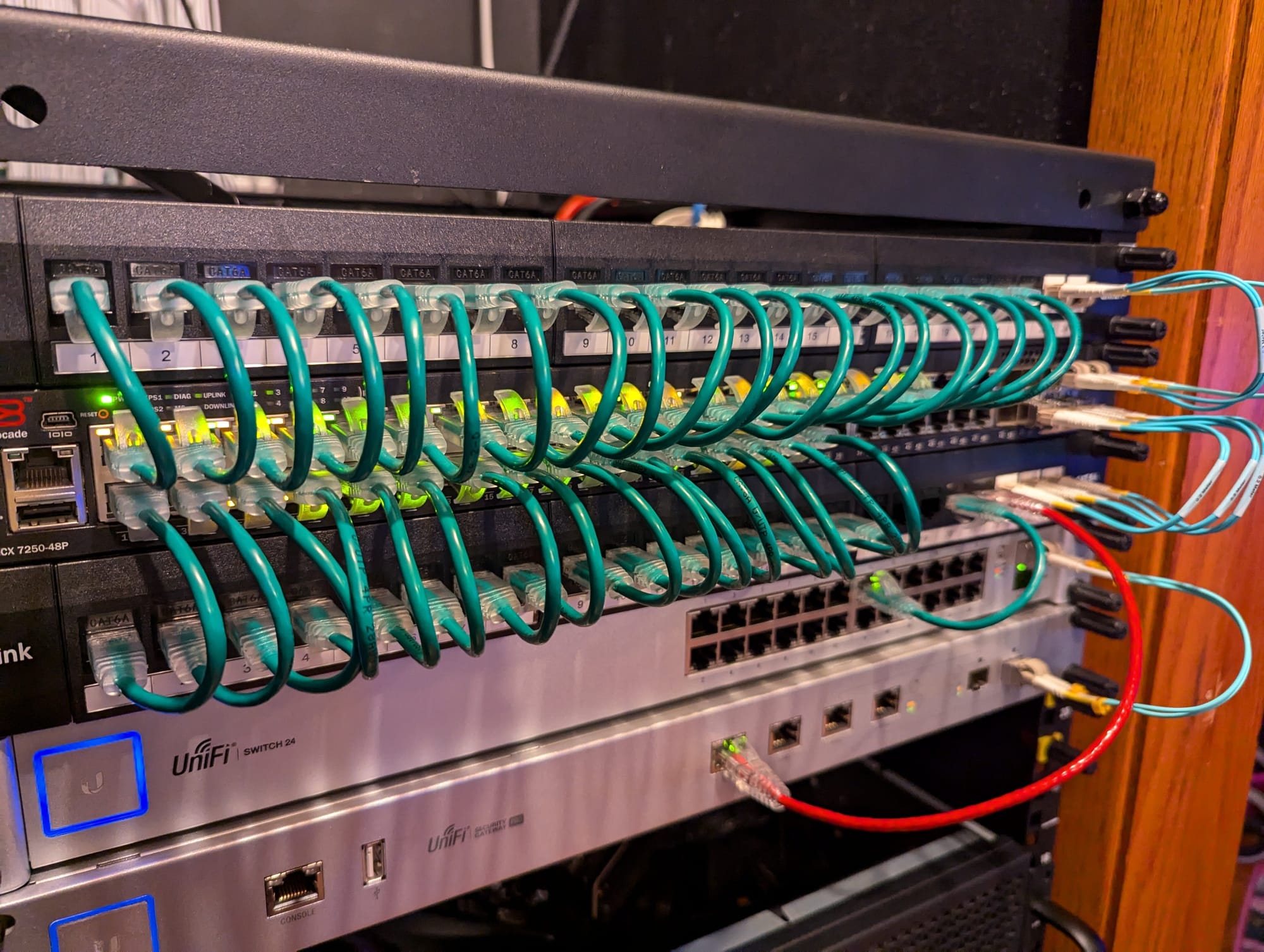
The main networking was complete, but I still had much work to do. I ordered a fancy new UPS and a shelf for Tubs and got to work getting everything on to the rack. While this was going on, I was also doing research and picking out parts for what I was still thinking of as the AI server. My original plan was to build two servers for the rack. One to handle the AI duties, and one to handle the mission critical automation and security jobs. I was looking at older used enterprise gear, trying to match the luck I had with Switch. I'll go over my choices and reasoning in the next article.

Member discussion: