
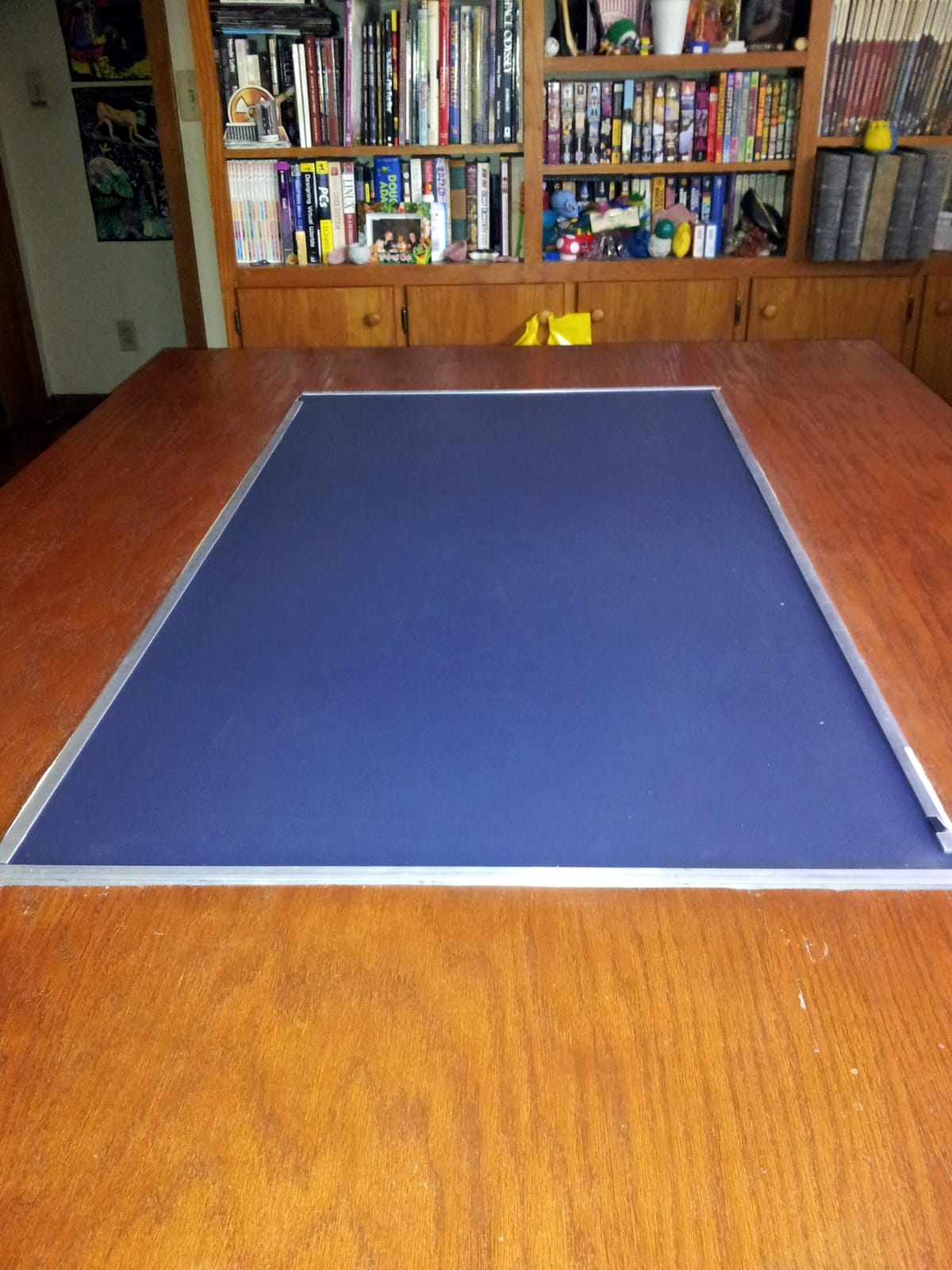
The table was an ambitious project I took on way back in 2009-2010. At the time, I was looking into ways to amp up our Table Top Role Playing Games, both the game with the kids - and the other campaigns we played with our adult friends. I...may have gone a little far.
It started life as the contact surface for a very early touchscreen interface I was working on around 2010 or so. This used an IR camera (I used an old playstation eye camera with a modifed lens) sitting on the floor to look up at the surface of the acrylic (roughly 28" above) and watch for disruptions in the light. I then picked up a piece of fancy Endlighten acrylic (Now called Acrylite LED and edge wrapped it with 850nm IR leds. The way this acrylic works, it bounces the light inside the medium until it is disrupted by an external distortion (like your finger touching the panel). I coupled this with a short throw VGA projector bounced off a mirror, and I had a multi-touch capable PC interface with a table sized display within a couple years of the first iphone.
The technique was called DSI (Diffused Surface Illumination) Multitouch. I don't have any video of mine in action, but here is a video made by a member of the research forum I participated in while developing and building this - the seemingly now defunct nuigroup forums. I did not invent or create anything new, just adapted and combined the ideas of others into something that was more me.
I don't have a ton of pictures, but I did keep a few.
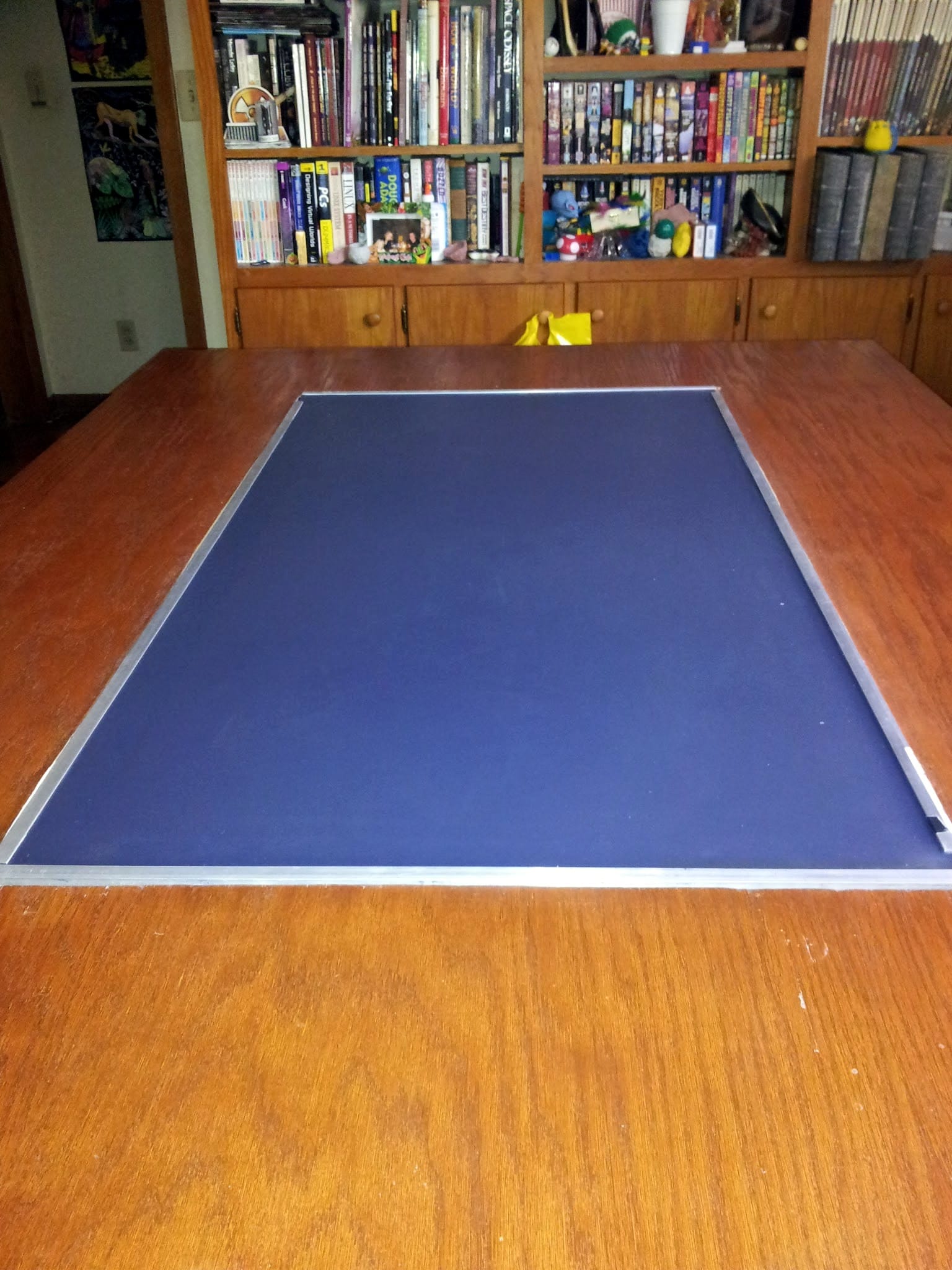
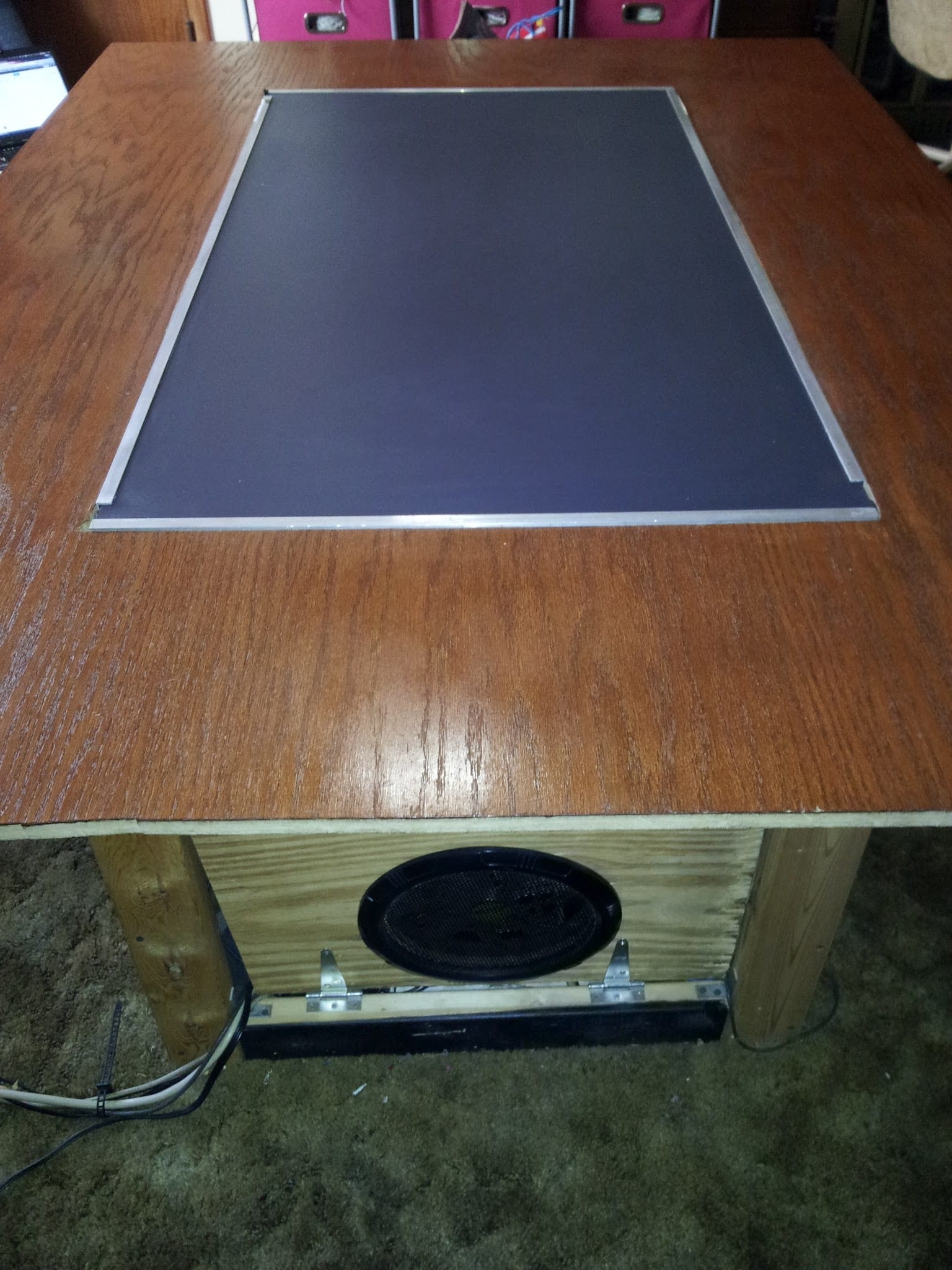
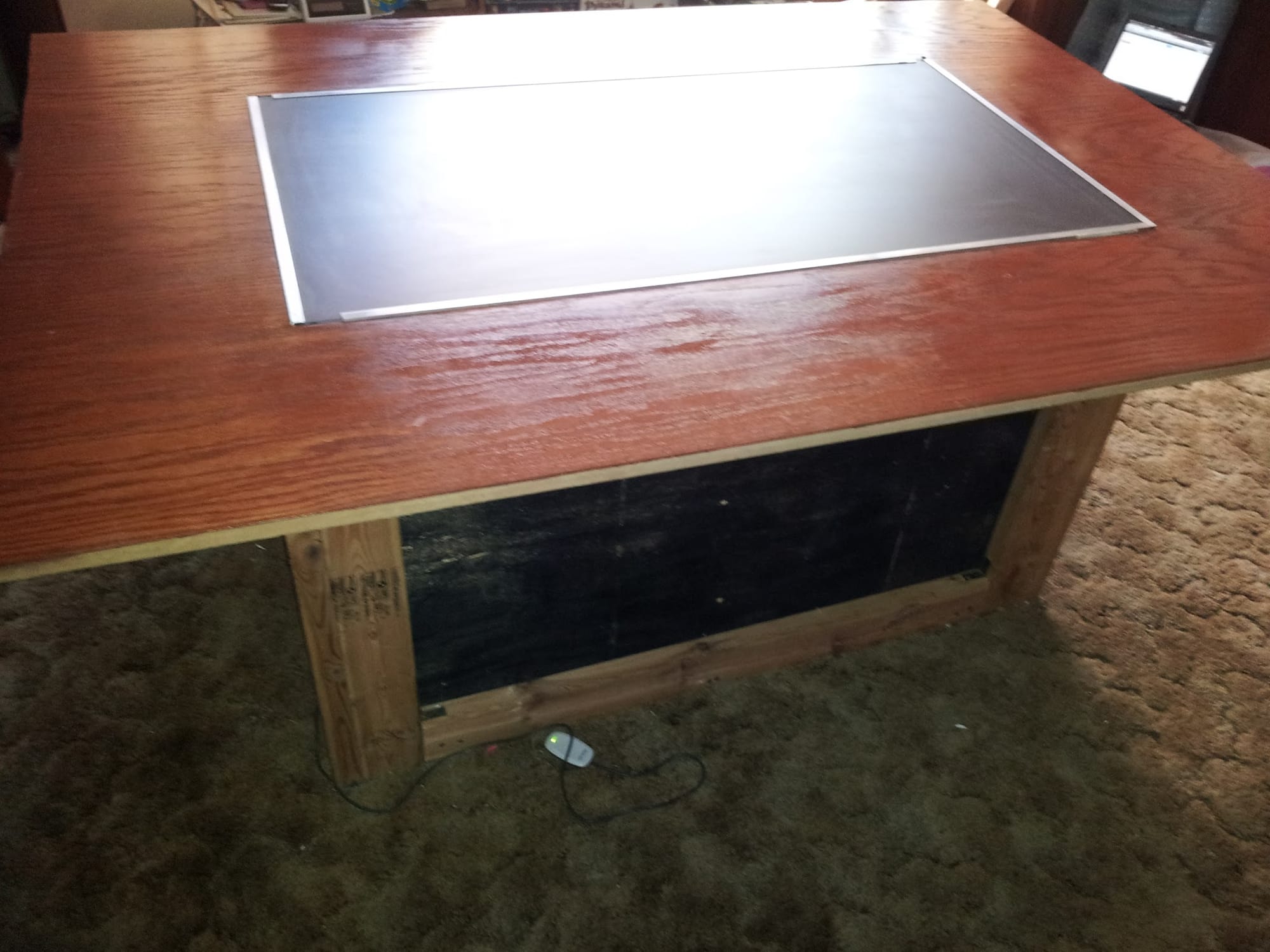
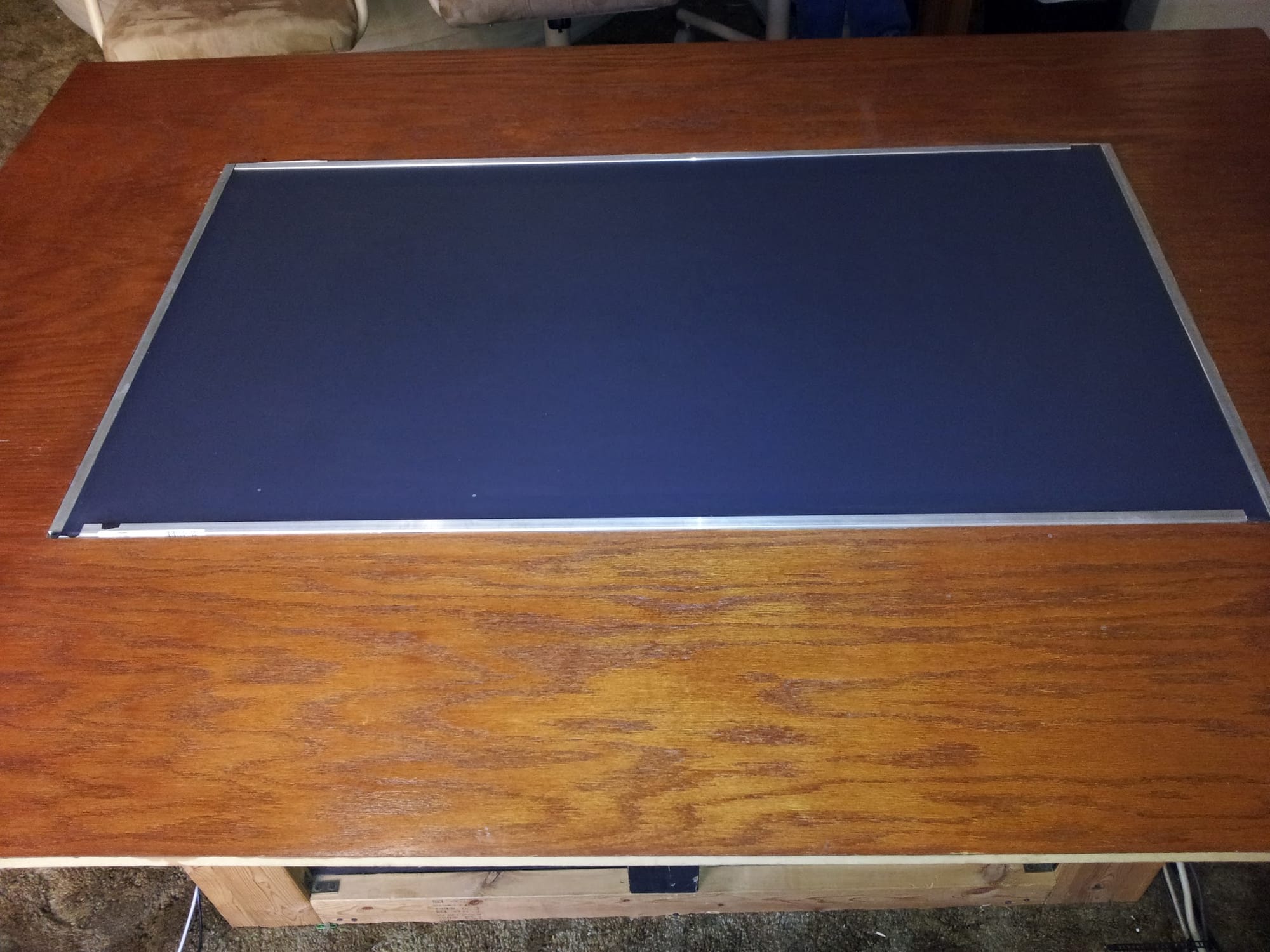
The exterior of the table was about 8' x 4'. The screen was 44" x 24"
Amy and I spent a ton of time on the table surface. It is definitely the part that came out nicest. The surface was 3/4" oak veneer, which took a very nice stain. I don't have much experience with this stuff, so I probably made some major gaffs doing it, but I liked how it looked, and the wood still looks nice, today. If I were to build this again, however, someone else would do the woodwork, and I would stick to what I am good at. The side panels were 1/2" plywood (I wanted them strong enough to support the projector mount and be resistant to kicking feet), the rest was 2x4s and 1x4s. Garage engineering. I used what I knew.
Between the projector and the PC, I was worried about heat down there, hence the giant fans. They were pretty quiet, and moved a reasonable amount of air. Intake on one side, exhaust on the other. It was a decent plan, but it turned out to not matter much. The volume of air inside of this box was so large, the projector and PC hardly affected it.
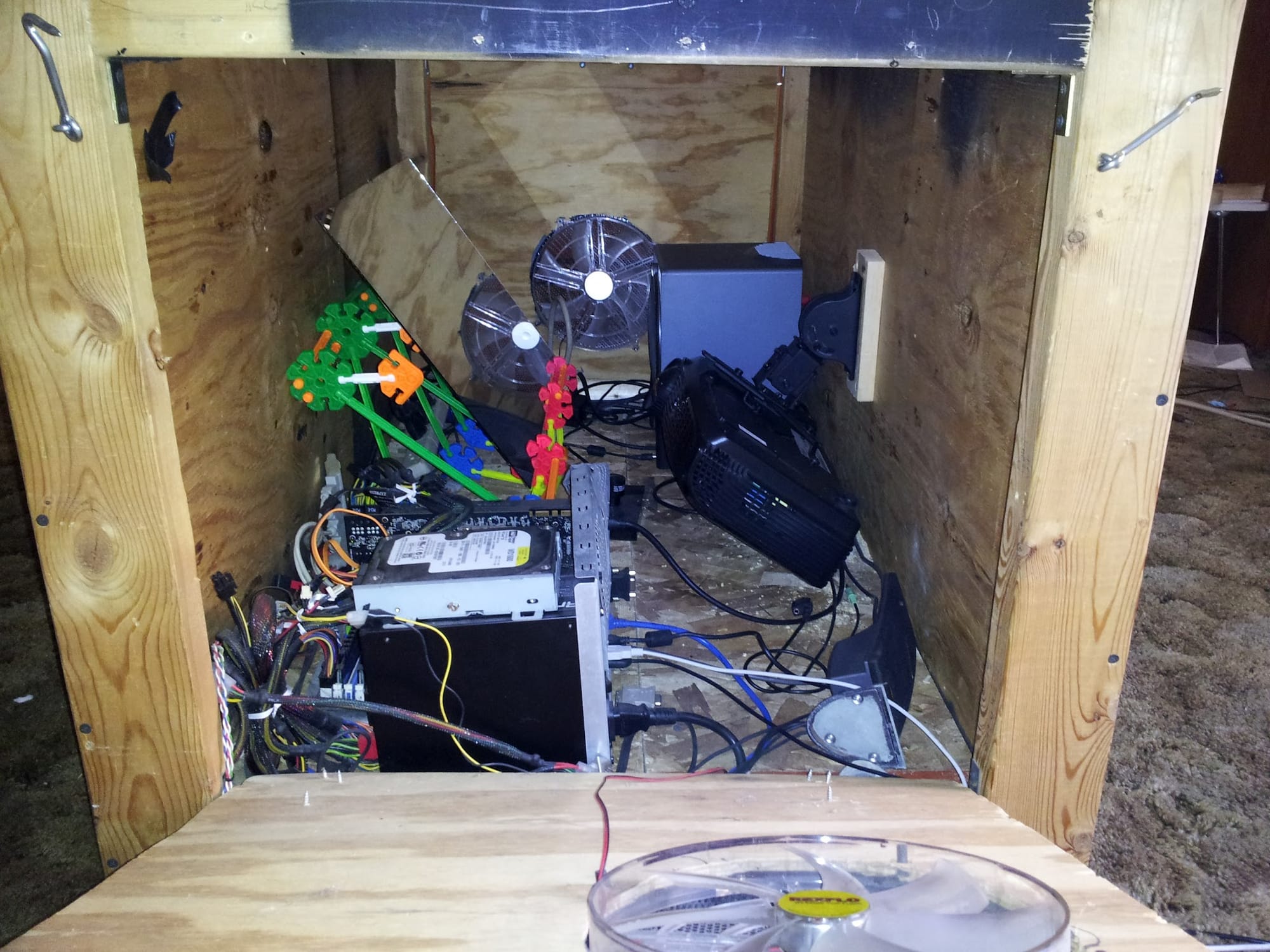
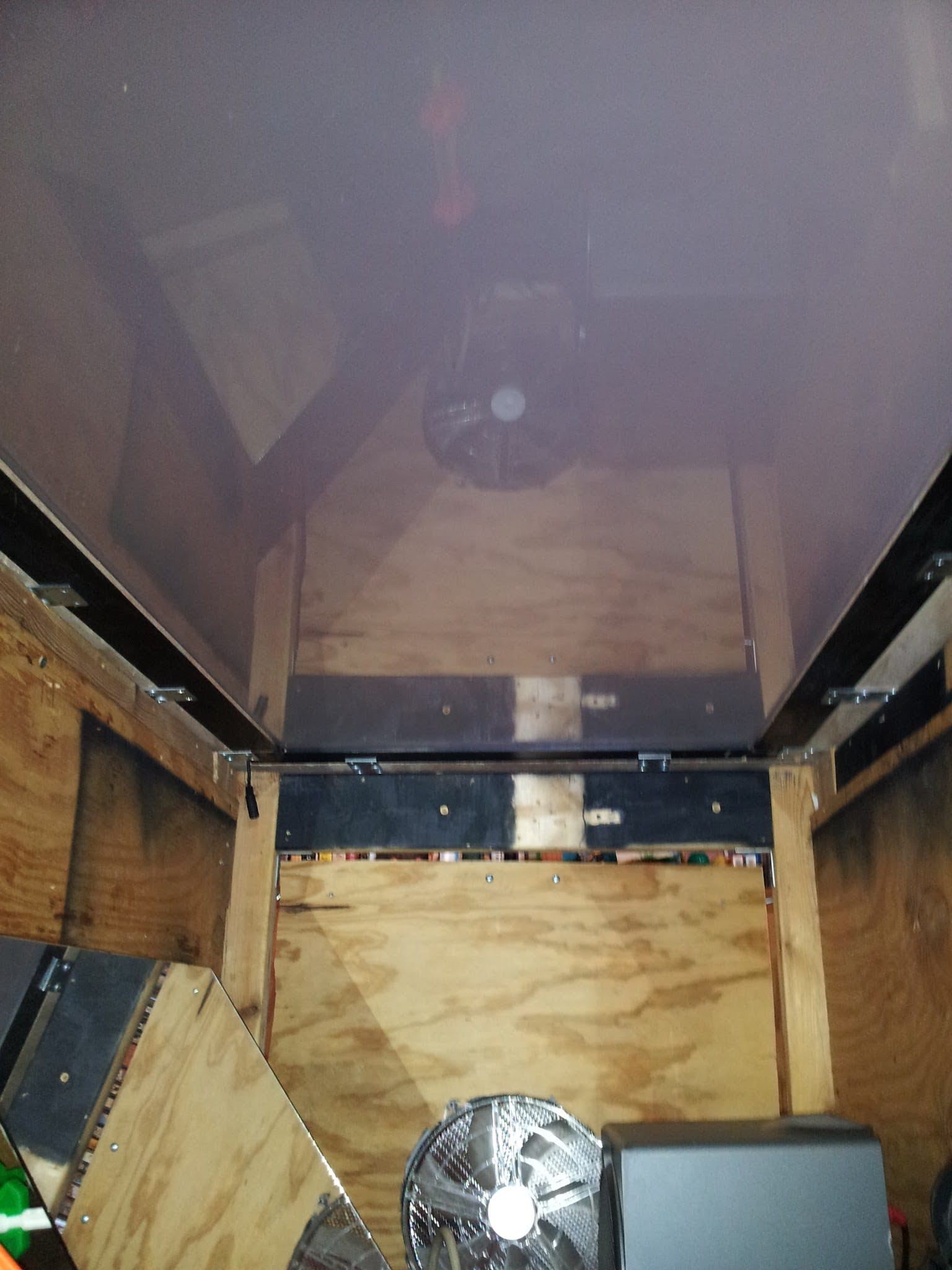
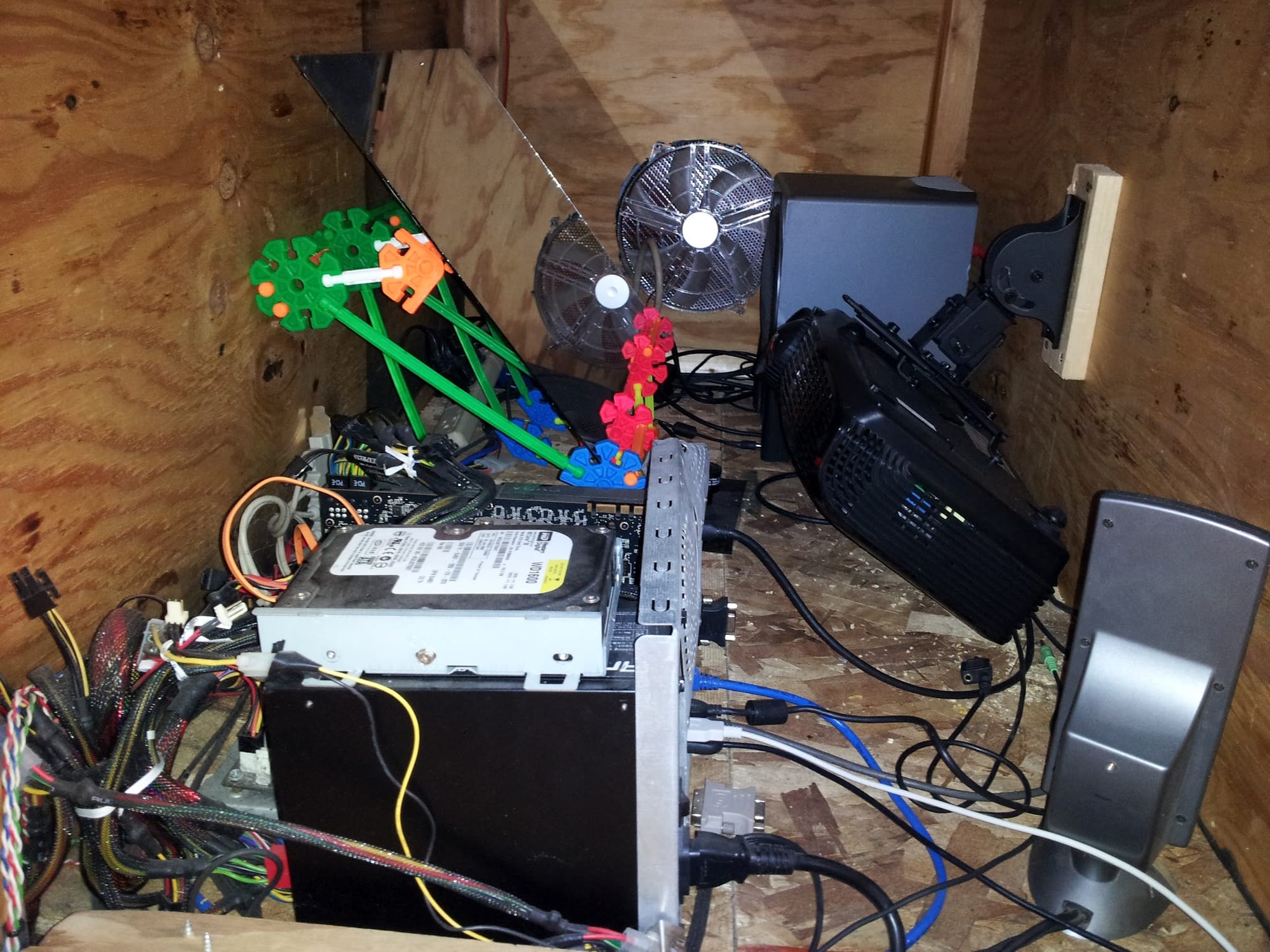
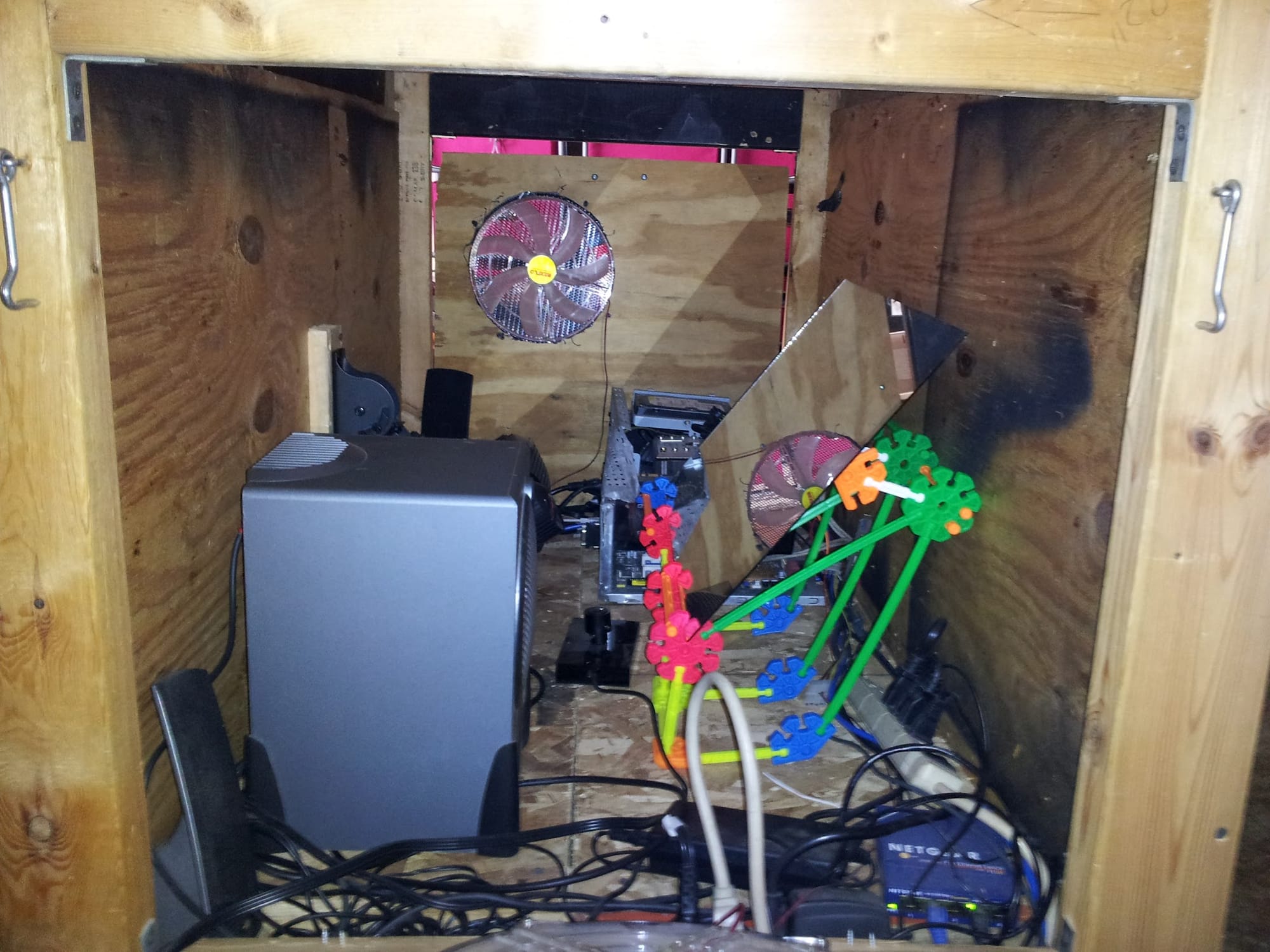
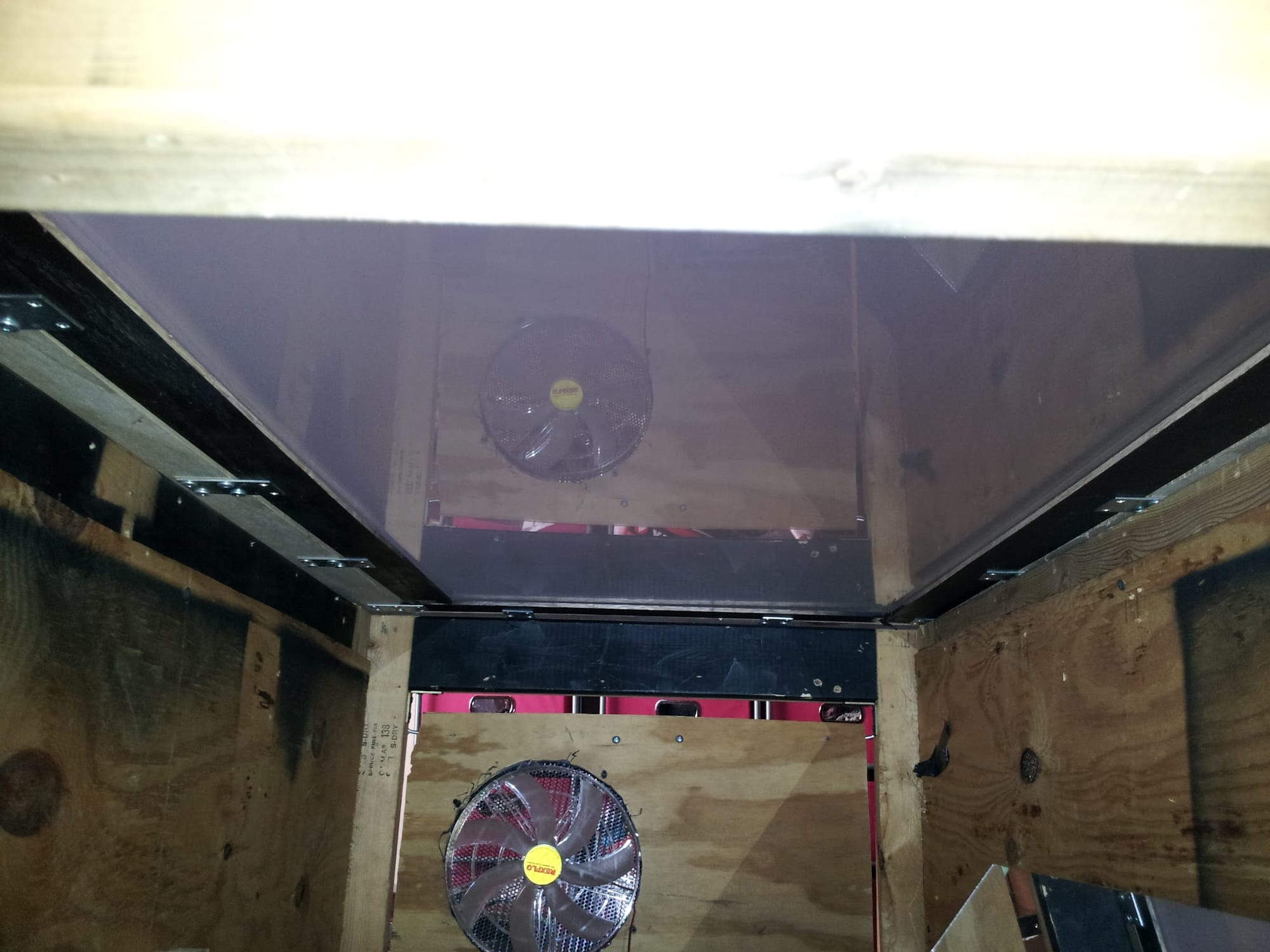
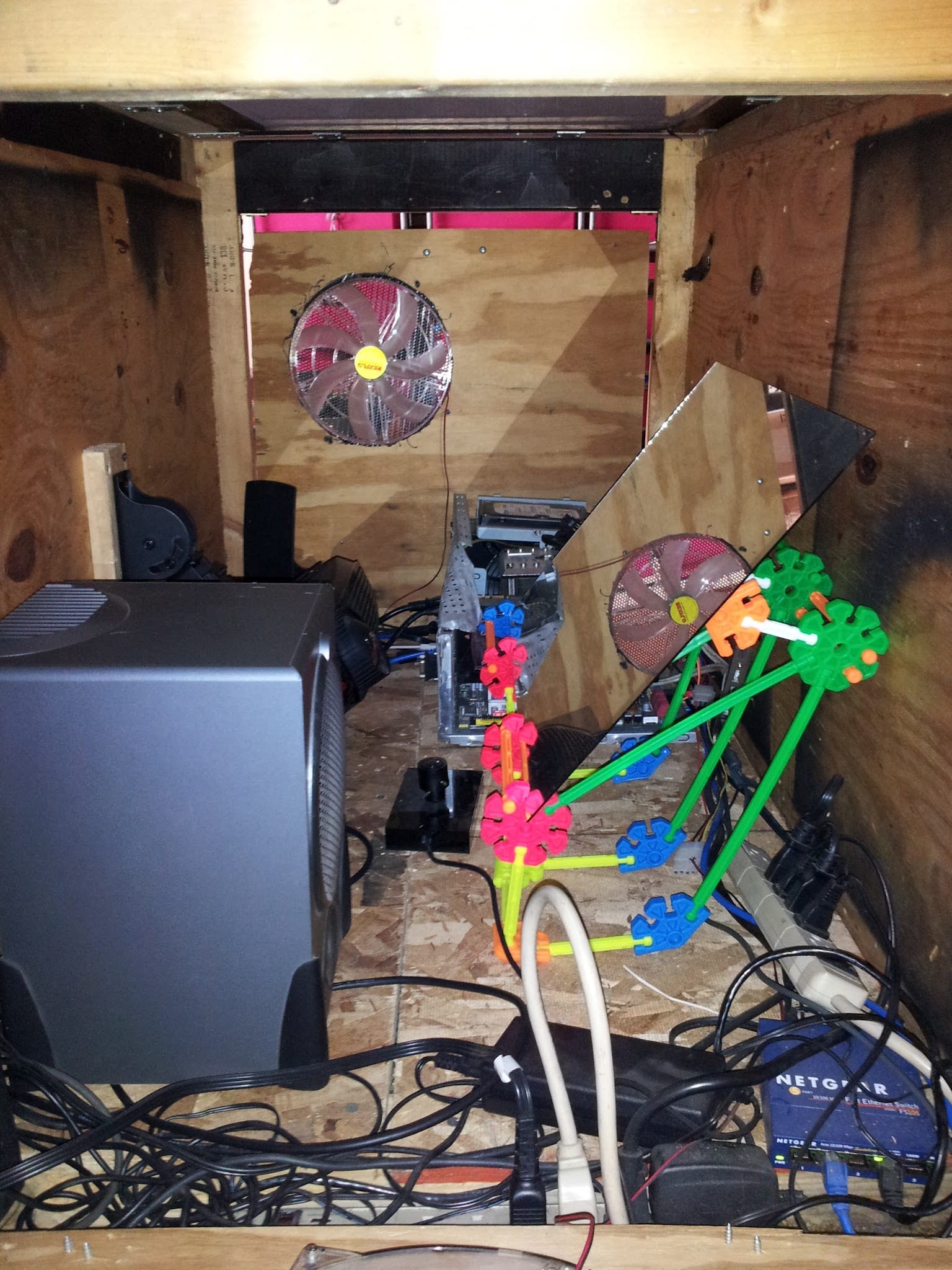
If it looks cramped and cluttered, it was. Still, it had all the amenities, even a subwoofer. Marvel at my mirror holder made from Kid K'Nex!
The projector throw was short, but not quite short enough to just be pointed straight up. I ended up having to bounce the display off of a 1st surface mirror to get the picture nice and clear on the surface above. If we were to use this for gaming, text had to be legible!
The panel itself was a sandwich of a few different things which all nested inside of the wooden cutout sitting on a wooden frame. The bottom layer was a piece of plain acrylic (plexiglass) that was just there for strength. (This would later be removed, but it is visible in the pictures, so I'm including it). Above that was the Endlighten acrylic, for the touch detection, and above that was the diffuser and touch interface surface. I went through a few of these. If you have ever tried dragging your fingers across plastic, you know that it doesn't make a good touch screen interface. We didn't have things like Gorilla Glass back then, so we had to get creative.
I tried a bunch of diffusers here. Basically, I would place something between the Endlighten and the touch surface. (The touch surface started as plexiglass, but that was uncomfortable to drag across). I started with tracing paper, then tried vellum, a bed sheet, packing foam, anything I could think of. It was around this time that I met Tobias at PAX. Tobias had a startup called Mesa Mundi that was building as its product exactly the sorts of things I was working on at home for fun. (This has become something of a pattern for me). I ran into him at several consecutive PAXes (PAXen?) and we always enjoyed talking shop. At one show he told me about Evonik's 7D006. This was apparently the 'surface' on the Microsoft Surface. It was both a comfortable touch surface, as well as an amazing light diffuser. It was also pretty expensive. A 44" x 22" x ~3/16" sheet cost me about $370 shipped in 2011. An amount which Amy points out is approximately (raises pinky) $3 million dollars today.
I rebuilt the sandwich as just the Endlighten and the 7D006, and the experience improved tremendously. Sadly I have very few pictures of the table in use, as I was young and foolish and didn't take many. Ironic, considering it had a literal camera involved in its primary function.
One advantage of the touch interface utilizing a camera was I could import other visual data as well. I experimented a bit with printing out and gluing fiducial markers to the bottom of tokens and game pieces to track their location with the camera. I never did anything more complicated than location on a hex map or tracking which player's zone contained a piece, but it was cool to play around with. The software could, for example, superimpose allowed movements onto the screen, right under your character token or minifig, sort of like a video game.
Of course, it was a Gaming PC, it could run games as well. Some games, like Torchlight II, RPGs and ARPGs in general, worked really well on the touch surface. Others, like Minecraft, just benefited from the large for its time display.
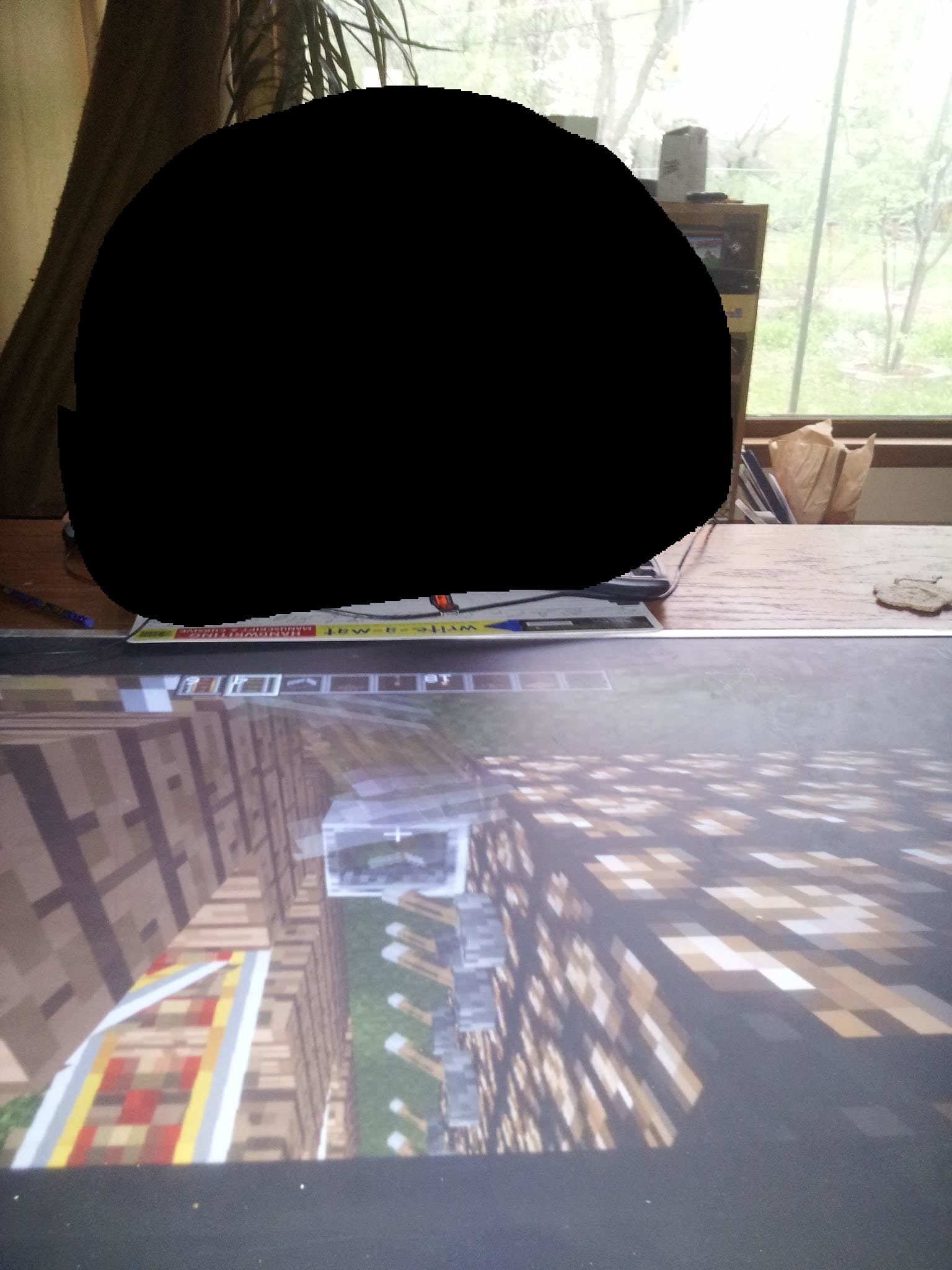
D20 Pro incorporated some of these features into its software back then, although I don't know if they still support it.
We spent way too much money on this project all together. It was really cool, don't get me wrong, but once you add up the computer, projector, multiple types of fancy acrylic, the wood surface, etc. It all adds up to more than I am going to think about right now.
One thing we didn't have to pay for was the CPU. In a stroke of luck, I won a rather fancy Intel CPU at PAX in 2010 (an i7 980x if I remember correctly). Of course, I had to build an entire system around it with parts that could utilize that sort of CPU, so I am not sure it was a net gain. Still, it was a fun PAX moment.
Newegg's order history viewer only goes back to 2015, but today I learned if you input the order number, it can go back further. Because of that, I still have the specs of this system:
- CPU | Intel i7 980x
- MBD | ASRock X58 Extreme LGA 1366
- RAM | 6gb G.Skill Ripjaws DDR3200 (PC3 16000)
- GPU | EVGA GeForce GTX 470
- PSP | Antec EarthWatts EA750 ATX
- HDD | Samsung 2TB SATA with 32MB Cache
By today's standards, this isn't a lot to sneeze at, but it certainly had power at the time. The GPU would later be upgraded to a GTX 980 Hybrid deal, the ram doubled to 12gb, and the HDD replaced with a solid state. This system was still in service until about a year ago. I still have the surviving parts, but the power consumption to compute ratio makes them not worth reusing any longer.
Eventually I lost interest in the project. If you thought prepping adventures for table top gaming was a lot of work in paper, wait until you have to not only prep the software, but build the software you are going to use. I burned out while building campaigns, and eventually the computer named "Table" was repurposed as a media server. (although it retained the name, which I continue to find hilarious). The 7D006 is leaning against a wall in my garage. The Endlighten is now the light called "Panel" which dominates the standing side of our living room. The table surface was used as our primary gaming/dining table for years, but eventually we wanted something smaller. I disassembled the box underneath, and the table surface now serves as the headboard for our bed. The system itself was our main HTPC until it was replaced by Neo, after which it spent a brief time as our bedroom HTPC until it was eventually retired in late 2022.
The build was a lot of fun. The end product was certainly a head turner. Keep in mind, at the time the iPhone had just come out a couple years prior. While commonplace today, multitouch in computers was completely new territory in 2010, and touchscreens in general were still not very widespread. Once I had the hardware built and working, I found I had to develop a lot of the software support myself, because a lot of the tools I needed just didn't exist yet. That contributed a lot to my burnout on the project, it was far less interesting than building new ways to interact with PCs.
In some ways, the AI rush today reminds me of this time. A ton of new ideas are being researched and developed in the open, looking to see what sticks. Everyone can feel we are building towards things that will be world-changing and ubiquitous in a few years (much like touchscreens in 2010, the Internet in 1995, and the PC in the early 80s). I'm glad I am still in a position to tinker around with these new technologies and see what new things I can come up with.

Member discussion: