
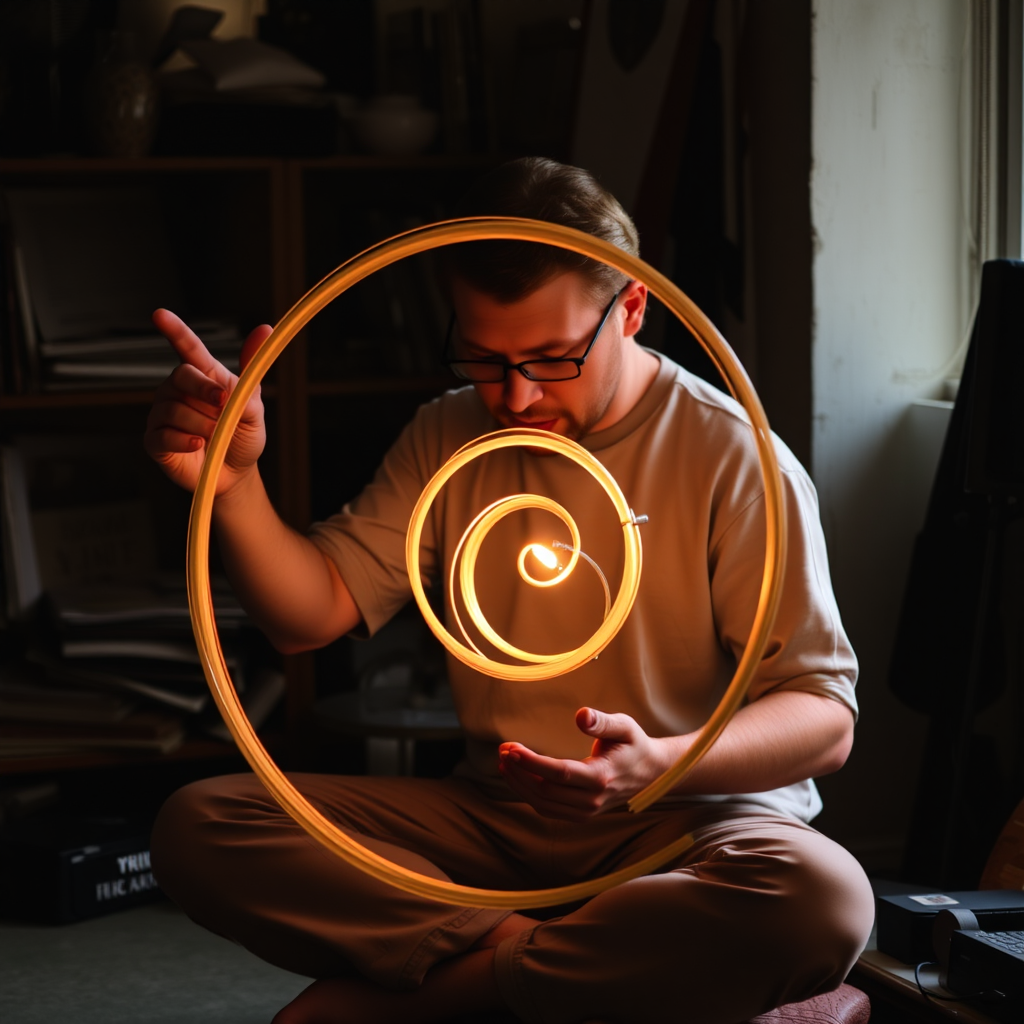
Wikipedia defines live looping like this:
Live looping is the recording and playback of a piece of music in real-time using either dedicated hardware devices, called loopers or phrase samplers, or software running on a computer with an audio interface.
In practice, this generally leads to a more complete (or at least more complex) output than what would be possible otherwise. I first got into live looping when I had kids, and didn't have as much time for playing out with the band as I used to. I still had music I wanted to make, but my schedule wasn't as flexible, so I had to make do with what time I could budget.
Mechanically speaking, I already had some experience with this sort of music production. Without intending to, the rules I set up for my 60 Seconds to Go project mirrored live loop production pretty closely. I would pick an instrument, play for a minute, then repeat. Adding more sound as I went. Live looping just helped to automate the process so that I could do it performatively.
The Gear
My first looper was a Digitech RP155 guitar pedal, and as these things went, pretty simple. You tapped it when you wanted it to listen, and the next tap would stop the recording and start looping playback until you hit it again. This worked all right, but the UX never really gelled with me. It could only loop about 20 seconds or so. I outgrew it quickly and started looking for something better.
The second piece of gear I utilized for this was a Korg Kaossilator Pro+. This was a pretty major upgrade from the pedal. It features four separate looping tracks, has some built in synthesis capability, and some built in drum loops. I jammed with this setup for years, and it worked fine for my uses, but eventually its limitations caused me to look for something more purpose built.
In 2020, I picked up a Boss RC505 Loop Station. This had five separate looping tracks, a ton of built in effects, and much more versatility. It enabled a ton more creativity over what I had before, both because of the added feature set, but also because it had a mess of inputs. This allowed me to have more instruments connected at a time, reducing the friction inherent in using a wide variety of sounds. Of course, I kept the Kaossilator in the mix, giving me 9 loop tracks without layering.
By 2024, My 505 had seen a ton of use (and abuse) and was starting to show signs of failing. It worked reliably enough, but sometimes it would miss button hits or triggers, and I had a bit of GAS and wanted something new. I looked to see if there was anything that would work better for my workflow, but didn't see anything I liked more than the updated Boss RC505 mkii.
The 505mkii added 5 more loop tracks (14 now! although don't really loop with the Kaossilator anymore) as well as a mess more inputs. Combined with my mixer, this allowed me to connect virtually all of my instruments at once, which really reduced friction in playing whatever was in my head at the moment.
Workflow
So how does this all come together? I can't speak to how other loop artists do it, but my process is something like this.
- Noodling around with random bass or percussive sounds until something catches my ear.
- Play the beat/melody/riff/whatever until I get something catchy.
- At this point I usually pause playing, briefly, to program the temp and rhythm information into my gear.
- Start the looper and record whatever it was I liked.
- Pick another instrument (sometimes I choose intentionally, sometimes I pick at random).
- Noodle around for a few seconds until I have what seems like a good complimentary part.
- Go back to step 4 and repeat until satisfied.
Sometimes I have an entire song fully formed in my head, and just need to get it recorded (either for future expansion later, or so I can finally move on and think about something else!). Other times the songs grow organically and proceed in unexpected directions.
About a third of the time, the loops will evolve and mix and mesh, and five minutes in will sound 100% different than the beginning. I don't usually plan for this, I just play and whatever comes out is what I am making.
Live Only
I don't really care for audio production. I don't like DAWs, I don't like most music software, and I am the type to easily fall into a black hole of perfectionism. Because of this, I don't usually intend my liveloops to be "finished songs". Think of them more as "live performances" because, of course, that is what they are. Sometimes I have an audience while playing, sometimes I am just playing for fun. I am a strong believer that restrictions and rules breed creativity. Mistakes sometimes make the song go in a new direction, and that can be fun.
If I sat down and tried to "produce" any of these tracks, I'd never release anything. It will always be of slightly less quality than commercially available music because of the lack of production, but I don't really care about that. I make music for me. If other people like it, great! If not, well, I still have the stuff I like. Because of this, I never get too hung up on any one track or sound or whatever, and I am free to move on to new ideas without all of the mental baggage of "unfinished work".
I recently made a "Jam Button" that allows me to save stuff that I liked while playing, and because of that, I do have an ever growing list of recordings of stuff I liked. I'll link some, below.
Patch Roulette
I mentioned I try to introduce constraints in order to encourage creativity. "Patch Roulette" is giving a name to a technique I've used for a few years to accomplish this. The idea is - when I record a sound, I then randomize the patches on my instrument, and whatever sound comes up (no matter how weird, silly, or discordant), that is my next patch. The goal is to make a decent sounding track, live (of course), utilizing only the randomly selected sounds that come up. This can not only lead to some crazy songs, it also forces me to gain experience with less common sounds and how to use them. A lot (probably close to 1/4) of the "Random Jams" tracks linked below were made this way.
I enjoy this style of songwriting a lot. It is always fresh, avoids a lot of practice ruts, and forces me to think on my feet and improvise, which I like.
Random Jams
So here is a link to my 'Random Jams' folder, which has everything I've saved with my "Jam Button" so far. These tracks were all recorded live, utilizing the process and gear outlined above. The only editing my jam button does is to cut the waveform to the largest contiguous section, and amplify. I don't run any compression or effects after the fact. Anything you hear is how it sounded when I played it live in my living room. I try to limit these to around 10-15 minutes tops, which is short for a "jam session", but long for a "song". The genres are all over the place, if you don't like what you are hearing, the next track is likely completely different.
Older Jams
Before I got the 505mkii and before I made my jam button, I would sometimes run the looper output to Reaper, (or sometimes just hit record on my mixer, which has a MTR). The tracks below are from those sessions. These are all from 2020 or before, are each far too long, and lack some of the refinement of my contemporary recordings. Still, some of them are fun for driving or coding background music, so I am including them here. These are more "jam sessions" than anything else. There are a lot more psybient/ambient tracks here.

Member discussion: